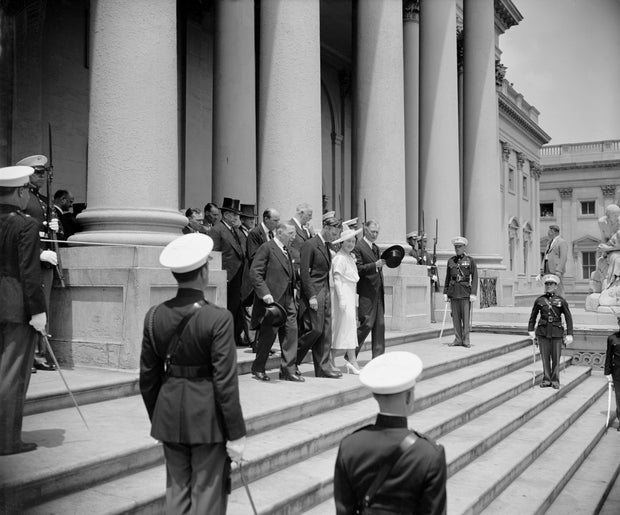
Photographs don’t just capture faces—they freeze history in grain, light, and gesture. When a British monarch steps onto American soil, the images that follow become part of a living archive: diplomacy made visible, tradition meeting republicanism, and soft power in full display. As King Charles III embarks on his first state visit to the United States, the world watches not just for political messages, but for the visual language of continuity and change.
These moments—Queen Elizabeth shaking hands with a crowd in Philadelphia, Prince William tossing a football in Texas, or Charles embracing President Biden outside the White House—are more than photo ops. They’re carefully choreographed symbols of a complex transatlantic bond. And as new images emerge from Charles’s visit, they join a century-long visual narrative of royal presence in the U.S.
The First Royal Footprint: Edward VIII’s Pre-Coronation Stop
Long before state visits were formalized, members of the royal family made informal appearances in the U.S. One of the earliest documented royal figures on American soil was Edward, Prince of Wales—later Edward VIII—during his 1924 tour.
Photos from that trip show a dashing young royal in flapper-era America: inspecting Ford factories in Detroit, waving from open-top cars in Manhattan, and attending polo matches in Maryland. Black-and-white stills capture the prince in a crisp suit, smiling before crowds who saw him not as sovereign, but as celebrity.
That visit wasn’t diplomatic in the modern sense—no heads of state formally hosted him—but it laid groundwork. The U.S. press covered him like a movie star, and the photographs helped humanize a monarchy that, post-WWI, was navigating a shifting global role. Edward’s tour proved that royal visibility could shape international perception—a lesson future monarchs would refine.
Queen Elizabeth II: The Gold Standard of Royal Visits
No royal has defined the visual history of British visits to the U.S. like Queen Elizabeth II. Her five official trips spanned nearly six decades, each visit marked by iconic imagery that blended ceremony with cultural connection.
1957: A Young Queen in the Cold War Spotlight
Her first stop as monarch was in October 1957, a politically charged moment. The Soviet Union had just launched Sputnik, and U.S.-U.K. alliance was under strain. Elizabeth and Prince Philip were invited by President Eisenhower to stay at the White House—a rare honor.
Photographs from that visit are rich with symbolism: the Queen in a pale pink dress addressing a joint session of Congress, the first British monarch ever to do so; her and Ike laughing during a picnic at Camp David; her inspecting troops at West Point in a tailored coat and pillbox hat.
These images weren’t just news—they were propaganda of goodwill. The U.S. media portrayed her as both regal and relatable, a stabilizing figure amid nuclear anxiety. Her ability to stand at ease in such high-stakes settings, captured in mid-century photojournalism, helped cement her status as a global icon.
Later Visits: Tradition Meets Pop Culture
Subsequent trips in 1976, 1981, 1991, and 2007 added layers to her American legacy. The 1976 bicentennial visit is especially iconic: she sailed up the Thames River on the royal yacht Britannia as part of the U.S. celebration, wearing a white dress and hat that mirrored colonial-era fashion. Photos of her waving from the deck became textbook images of transatlantic unity.
:max_bytes(150000):strip_icc():focal(728x275:730x277)/princess-catherine-prince-william-donald-trump-king-charles-iii-trump-state-visit-uk-windsor-091725-8672599a27214b6f8ffdbb07fd7596e4.jpg)
In 1991, during the Gulf War, her presence signaled solidarity. She visited troops at Fort Hood and met with President George H.W. Bush. The images—her in a navy coat, standing solemnly beside American soldiers—spoke of shared sacrifice.
By 2007, her final U.S. visit, the visual tone had shifted. She toured Virginia’s colonial landmarks, attending events that highlighted shared history. One photo from Jamestown shows her smiling beside reenactors in 17th-century dress—a moment of historical echo, carefully framed.
Through it all, the Queen mastered the visual grammar of diplomacy: poised but warm, formal but accessible. Her photos didn’t just document visits; they told stories of endurance and alliance.
Prince Charles: From Heir to Head of State Before becoming king, Charles made more than a dozen trips to the U.S. His visits evolved from youthful goodwill tours to serious advocacy missions—reflected clearly in the changing tone of accompanying photos.
In the 1970s, images show a young Charles in blazers and sideburns, attending polo matches or shaking hands with local officials. By the 1990s, his focus turned to his passions: environmentalism, urban planning, and youth charities. Photos from a 1994 trip show him touring a Brooklyn housing project, listening intently to community leaders—a marked shift from ceremonial appearances.
One of the most telling images came in 2011. Charles and Duchess Camilla visited the Ground Zero site, laying a wreath at the 9/11 memorial. The photo—Charles in a dark coat, head bowed, Camilla beside him—resonated globally. It was a moment of shared grief, not politics. The image didn’t just show respect; it humanized the monarchy in American eyes.
Now, as King, his state visit carries heavier symbolic weight. Photos from his 2023 trip—walking with President Biden through the White House colonnade, attending a state dinner in velvet and medals, speaking at climate events—signal a new chapter. The visuals are still diplomatic, but layered with personal mission. He’s not just representing Britain; he’s advancing causes he’s championed for decades.
The Royal Children: William, Harry, and the Modern Image
While Charles and the Queen dominated the formal record, their sons have shaped the informal visual narrative of royal engagement in the U.S.
Prince William’s 2014 visit, following in his mother’s footsteps, included a trip to New York’s 9/11 Memorial. Photos of him placing a hand on a name panel—Diana’s name inscribed nearby—were shared widely. It was a quiet, personal moment turned public through imagery.
His later trips with Kate Middleton leaned into diplomacy with a domestic touch: playing basketball in Philadelphia, visiting NASA, and meeting Ukrainian refugees in New York. The photos often feature the couple smiling, crouched to talk to children or trying local food—soft power through approachability.
Harry’s visits, particularly post-2020, have been more complicated. His 2023 trip with Meghan Markle, while not official, drew intense media attention. Images of him speaking at veterans’ events or attending private functions were scrutinized not just for content, but for contrast: a royal removed from duty, yet still commanding a spotlight.
These photos reflect a broader shift—royal influence no longer flows only through state dinners, but through social media, celebrity culture, and personal branding. The optics matter more than ever.
Beyond the Crown: What the Photos Reveal
The most powerful royal images in the U.S. aren’t always the grandest. They’re the candid ones: the Queen sipping tea with Betty Ford, Charles laughing at a jazz concert in New Orleans, William high-fiving a kid in Chicago.
These moments do more than entertain. They perform diplomatic labor:
:max_bytes(150000):strip_icc():focal(749x0:751x2)/king-charles-III-state-visit-of-the-president-of-the-republic-of-south-africa-112222-4-806910a78d3444cf87ef8dcb828390e0.jpg)
- They soften hierarchy. A monarch waving from a balcony is distant; one eating a hot dog at a baseball game is relatable.
- They signal alignment. When royals attend 9/11 memorials or climate summits, the photos say: “We share your values.”
- They bridge time. A photo of Charles in 2023, standing where his mother stood in 1957, creates visual continuity—proof of enduring alliance.
But they also expose limits. Not every image lands. Charles’s 1995 visit, during the Diana divorce saga, was poorly received. Photos of him at formal dinners felt tone-deaf amid tabloid frenzy. Similarly, Harry’s post-exit appearances raise questions: Can a non-working royal still represent national unity?
Visual diplomacy is fragile. A misjudged gesture, a poorly timed smile, a wardrobe choice—each can be magnified by the lens.
The State Visit in the Digital Age
King Charles III’s 2023 state visit unfolded in a media environment his mother never knew. Every handshake, speech, and dinner toast was photographed, filtered, and shared in seconds.
Official photos released by Buckingham Palace are polished: Charles in white tie and insignia, Carrie Johnson in a striking red gown, fireworks over the Washington Monument. But the real impact comes from the unscripted images—the King pausing to speak with a veteran, chuckling at a joke from Biden, or touching a exhibit at a museum.
Social media amplifies these moments. A single candid can trend globally. This changes the stakes. Royal visits are no longer just for newspapers and evening news—they’re content in a 24/7 attention economy.
And yet, the core remains: the photo that endures is the one that feels true.
Closing: What to Watch for in Future Visits
As King Charles III continues his reign, his U.S. visits will add new chapters to this visual history. Future photos will likely emphasize climate advocacy, youth mental health, and military support—causes central to his identity.
But beyond the agenda, the lasting power of these images lies in their ability to show connection. Not just between nations, but between people. When a monarch bows his head at a memorial, or a princess laughs at a school play, the camera doesn’t just record a moment—it builds legacy.
Look closely at the next royal photo from American soil. It’s not just a picture. It’s history, speaking silently through light and shadow.
FAQs
Did Queen Elizabeth II visit the U.S. more than any other British monarch? Yes, she made five official state visits—more than any other British sovereign.
Was Edward VIII’s 1924 U.S. trip considered a state visit? No, it was an unofficial tour. He was Prince of Wales at the time and not hosted by the U.S. government in a formal diplomatic capacity.
What was King Charles III’s first U.S. state visit as monarch? His first was in 2023, though he had visited the U.S. over a dozen times before as Prince of Wales.
Do royal visits to the U.S. have diplomatic significance? Yes, they strengthen bilateral relations, symbolize alliance, and support soft power diplomacy.
Why are photos from royal visits so widely shared? They combine celebrity, history, and politics—making them highly engaging for global audiences.
Has any British monarch addressed a joint session of Congress? Yes, Queen Elizabeth II did so in 1957, becoming the first and only British monarch to do it.
How do royal family members prepare for U.S. visits? They coordinate with both royal and U.S. officials on itinerary, speeches, wardrobe, and cultural sensitivities to ensure diplomatic appropriateness.
FAQ
What should you look for in Royal Moments: British Monarchs’ U.S. Visits Through Photos? Focus on relevance, practical value, and how well the solution matches real user intent.
Is Royal Moments: British Monarchs’ U.S. Visits Through Photos suitable for beginners? That depends on the workflow, but a clear step-by-step approach usually makes it easier to start.
How do you compare options around Royal Moments: British Monarchs’ U.S. Visits Through Photos? Compare features, trust signals, limitations, pricing, and ease of implementation.
What mistakes should you avoid? Avoid generic choices, weak validation, and decisions based only on marketing claims.
What is the next best step? Shortlist the most relevant options, validate them quickly, and refine from real-world results.