Poor communication is a silent hazard on job sites and in workplaces across industries. Misunderstandings, missed instructions, and lack of clarity don’t just slow progress—they create real danger. That’s where a communication toolbox talk PDF becomes essential. Unlike generic documents, this tool is designed to be practical, portable, and immediately useful during daily check-ins, safety meetings, and team briefings.
A well-structured communication toolbox talk PDF isn’t just a handout—it’s a dynamic resource. It primes teams to communicate more clearly, identify potential breakdowns, and reinforce expectations. Whether you're leading a construction crew, managing a warehouse team, or supervising field technicians, this document can be the difference between smooth execution and preventable errors.
Let’s break down what makes a communication toolbox talk PDF effective, how to use it, and what to include to maximize impact.
Why a Communication Toolbox Talk PDF Matters
Communication fails most often not because of complexity, but because of assumptions. Team members assume others heard the same briefing. Supervisors assume instructions were understood. In reality, gaps form quickly—especially in high-noise environments, rotating shifts, or multilingual teams.
A communication toolbox talk PDF addresses this by:
- Standardizing key messaging across shifts and teams
- Offering a consistent framework for daily talks
- Providing visual prompts and discussion points
- Reinforcing accountability for message delivery and receipt
For example, a construction foreman using a PDF guide can walk the team through specific communication checkpoints: - Did everyone hear the change in crane operation zones? - Has the hand signal for “emergency stop” been confirmed? - Are radio channels assigned and tested?
Without a structured tool, these details get lost. With a PDF in hand, they’re documented, discussable, and trackable.
Core Elements of an Effective Communication Toolbox Talk PDF
Not all PDFs are created equal. A useful communication toolbox talk PDF should be concise but thorough—typically 1 to 3 pages max. It needs to be scannable, actionable, and adaptable. Here’s what to include:
#### 1. Objective Statement Start with a clear purpose: Today’s talk focuses on preventing miscommunication during shift handovers.
#### 2. Key Communication Risks List 3–5 common pitfalls relevant to your environment: - Using unclear hand signals - Failing to confirm message receipt - Assuming shared understanding without verification
#### 3. Best Practices Provide actionable steps: - Use the “repeat back” method for critical instructions - Confirm understanding with yes/no questions, not “Do you get it?” - Assign communication roles (e.g., radio operator, spotter)
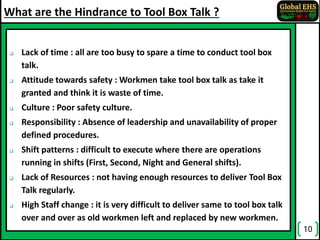
#### 4. Discussion Prompts Encourage engagement: - “Tell me how you’d report a blocked emergency exit.” - “What would you do if a team member isn’t responding to signals?”
#### 5. Visual Aids Include simple graphics: - Diagrams of approved hand signals - Flowchart for escalation paths - Noise level zones and required communication methods
#### 6. Sign-Off Section Allow team members to initial or sign, confirming they attended and understood the talk. This supports compliance and accountability.
Common Mistakes That Undermine Communication Toolbox Talks
Even with a solid PDF, poor execution reduces effectiveness. Watch for these recurring issues:
#### ❌ Reading the PDF Word-for-Word Toolbox talks should be conversations, not lectures. The PDF is a guide—not a script. If the supervisor reads every line without pausing for questions, engagement drops instantly.
Fix: Use bullet points as prompts. Ask open-ended questions. Invite team experiences.
#### ❌ One-Size-Fits-All Approach Using the same communication talk for a welding team and an electrical crew ignores context. Each has different noise levels, PPE barriers, and coordination needs.
Fix: Customize the PDF for job type. Include role-specific examples.
#### ❌ Skipping the Follow-Up** No one remembers a talk from three weeks ago. Without reinforcement, lessons fade.
Fix: Reference past topics in future meetings. Example: “Last week we talked about radio discipline—did anyone catch a miscommunication this week?”
#### ❌ Ignoring Language or Literacy Barriers If your team includes non-native speakers or lower-literacy workers, dense text fails.
Fix: Use icons, color coding, and multilingual summaries. Pair the PDF with verbal walkthroughs.
Real-World Use Cases
#### Case 1: Wind Farm Maintenance Team Challenge: Technicians work in remote areas with spotty radio coverage. Miscommunication led to a near-miss when two crews entered the same turbine zone.
Solution: The supervisor introduced a communication toolbox talk PDF focused on pre-entry check-ins. The document included: - A checklist: “Radio test? Zone confirmed? Backup signal method?” - A visual map of turbine zones with hand signal references - A role assignment table
After four weeks of consistent use, coordination errors dropped by 70%.
#### Case 2: Chemical Plant Shift Handover Challenge: Critical process parameters were missed during shift changes, leading to pressure fluctuations.
Solution: The team adopted a PDF talk titled “Did You Hear That?” focused on handover clarity. It featured: - A fill-in-the-blank summary of key metrics - A “three-point verification” rule: verbal, written, and system-logged - A role-play prompt: “Explain yesterday’s pH fluctuation to your partner.”
Within two months, handover-related incidents were eliminated.
Top 5 Communication Toolbox Talk PDF Templates (Free & Customizable)
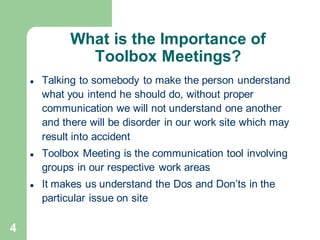
You don’t have to build from scratch. Here are five reliable, downloadable templates that work across industries:
| Template | Best For | Key Features | Access |
|---|---|---|---|
| OSHA-Compliant Communication Talk (SafeSite) | Construction, manufacturing | Pre-filled OSHA references, sign-off sheet, visual signal guide | Free download with email |
| Multilingual Toolbox Talk PDF (SafetyOne) | Diverse teams | Bilingual (English/Spanish), icon-driven, audio QR code option | Free PDF + paid customization |
| Digital-First Talk (SiteForm) | Tech-enabled sites | Interactive PDF with clickable checklists, embeddable in tablets | Freemium SaaS platform |
| Incident-Based Discussion Kit (ProSafe Tools) | Post-near-miss reviews | Root cause prompts, timeline builder, communication failure analysis | One-time purchase |
| Daily Communication Planner (WorkWell Docs) | Routine operations | Fillable fields, weekly planner, team feedback section | Free standard version |
Choose based on your team’s size, tech access, and language needs. Test one for a week—track engagement and incident trends.
How to Customize Your Own Communication Toolbox Talk PDF
Start with a template, but personalize it. Here’s a fast workflow:
- Identify a Recent Communication Failure
- Review incident reports or near-misses. Pick one where miscommunication played a role.
- Map the Breakdown Points
- Was it a signal misunderstanding? A missed handover? Language gap?
- Build the Talk Around That Scenario
- Turn it into a discussion: “What could we have done differently?”
- Add Visuals and Prompts
- Use photos from your site, real quotes, or diagrams of the actual work area.
- Test and Refine
- Run the talk with a small crew. Ask: “Was this useful? What’s missing?”
Save each version with a date and topic. Over time, you’ll build a library tailored to your operations.
Integrating the PDF Into Daily Workflow
A PDF on a tablet or printed sheet won’t help if it’s forgotten. Build habits:
- Schedule It: Attach the talk to the daily safety huddle—make it non-negotiable.
- Assign Rotating Leads: Let different team members lead the talk weekly. Increases ownership.
- Link to Tools: Clip the PDF to a laminated card, attach to a clipboard, or load onto shared devices.
- Track Completion: Use a simple log: date, topic, attendees, supervisor. Audit monthly.
One mining operation reduced miscommunication incidents by 60% in six months simply by enforcing consistent use of a communication toolbox talk PDF—paired with a 5-minute daily review.
The Bottom Line
A communication toolbox talk PDF is more than a compliance document—it’s a behavior-shaping tool. When designed well and used consistently, it builds a culture where clarity is expected, understanding is confirmed, and safety improves.
Don’t settle for a generic, forgotten file in a folder. Make yours practical, visual, and team-centered. Test it, revise it, and treat it as a living document.
Start today: download a template, adapt it to your last communication near-miss, and run your next talk with purpose. The goal isn’t just to talk—it’s to be understood.
FAQ
What should you look for in Communication Toolbox Talk PDF Guide for Teams? Focus on relevance, practical value, and how well the solution matches real user intent.
Is Communication Toolbox Talk PDF Guide for Teams suitable for beginners? That depends on the workflow, but a clear step-by-step approach usually makes it easier to start.
How do you compare options around Communication Toolbox Talk PDF Guide for Teams? Compare features, trust signals, limitations, pricing, and ease of implementation.
What mistakes should you avoid? Avoid generic choices, weak validation, and decisions based only on marketing claims.
What is the next best step? Shortlist the most relevant options, validate them quickly, and refine from real-world results.